Quai Network Explained: Two Tokens, Merge Mining and "Energy-Backed" Money
Not affiliated with this project. We received nothing for this page. Not financial advice.
Quick answer
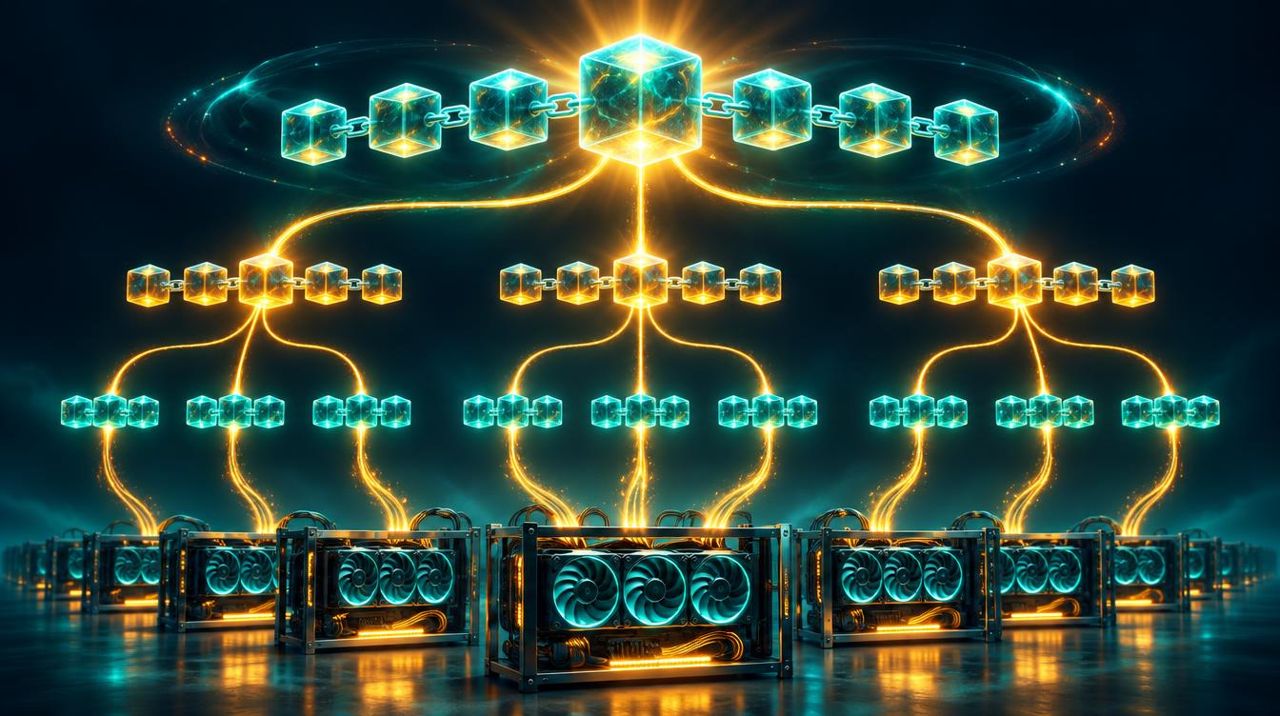
Quai Network is a proof-of-work blockchain that splits into a hierarchy of chains (one prime, three region and nine zone chains) mined at the same time, to get more throughput without giving up mining-based security. It has two tokens: QUAI, a scarcer store-of-value coin, and QI, designed to track the cost of energy used in mining. Its SOAP upgrade lets miners of other coins also secure Quai.
| Consensus | Proof of work with Proof-of-Entropy-Minima (PoEM) |
|---|---|
| Structure | 1 prime, 3 region, 9 zone chains |
| Tokens | QUAI (EVM, store of value) and QI (energy-linked money) |
| Mining | GPU mining plus merge mining via SOAP |
| Smart contracts | EVM-compatible on QUAI |
| Origins | Research that began around 2018 by a team linked to UT Austin |
What problem is Quai trying to solve?
Proof-of-work chains like Bitcoin are secure but slow. Most attempts to scale them add a second layer or switch to proof of stake. Quai keeps proof of work but runs many chains in parallel, arranged in a hierarchy. A miner's single hash is checked against the difficulty of all three levels at once, so the same work helps secure the whole network.
How the hierarchy works
- Zone chains process most transactions quickly.
- Region chains coordinate groups of zones.
- The prime chain ties everything together.
Quai's consensus rule, Proof-of-Entropy-Minima, picks the heaviest chain by measuring how much "randomness" each block removes, which the team says reduces forks. The headline throughput figures are theoretical peaks; real-world usage is far lower today.
QUAI vs QI: two tokens, one system
QUAI is the smart-contract token with an emission that slows over time, pitched as digital gold. QI uses a UTXO model like Bitcoin and its issuance is tied to mining difficulty, so its cost to produce tracks the energy spent mining it. Miners choose which token to receive and the protocol lets users convert between them at a set rate. The idea is a decentralised alternative to fiat-backed stablecoins, but QI is not pegged to a currency and its value can still move.
What is SOAP?
SOAP lets miners of other proof-of-work coins (the project has named Bitcoin Cash, Litecoin, Dogecoin and Ravencoin) merge-mine Quai and route value back into the network, including token burns. Quai says this adds security and revenue, with a longer-term aim of extending merge mining to Bitcoin.
Is QUAI worth watching?
Quai is one of the more technically original layer-1 projects, and it is listed on major exchanges such as Kraken. Its challenges are the usual ones for a new chain: attracting developers and users, and supply unlocks. Check the current unlock schedule before buying.
Main risks to know
- New consensus design with limited real-world stress testing.
- Throughput claims are peak figures, not current usage.
- QI is energy-linked, not a fiat-pegged stablecoin.
- Token unlocks continue for several years.
Frequently asked questions
Is Quai proof of work or proof of stake?
Proof of work. It uses a hierarchy of merge-mined chains and its own fork-choice rule called PoEM.
Can I mine Quai with a GPU?
Yes, GPU mining is supported, and miners of some other proof-of-work coins can merge-mine through SOAP.
What is the difference between QUAI and QI?
QUAI is the EVM store-of-value token; QI is a UTXO token whose issuance is linked to mining difficulty, designed for payments.
Is Quai EVM compatible?
Yes, smart contracts on QUAI use the Ethereum Virtual Machine.
Sources
- Project SOAP launches on Quai mainnet · Official SOAP announcement
- Quai Network launches SOAP · The Block coverage
- Quai supply check: QI, QUAI cap and unlocks · Supply and unlock schedule
- About Quai Network · Team and background
Figures such as prices, supply and user numbers change quickly. We cite the source and date; check the live figure before you act.