Render Network Explained: Decentralized GPU Rendering, RENDER Token and Burn-Mint Model
Not affiliated with this project. We received nothing for this page. Not financial advice.
Quick answer
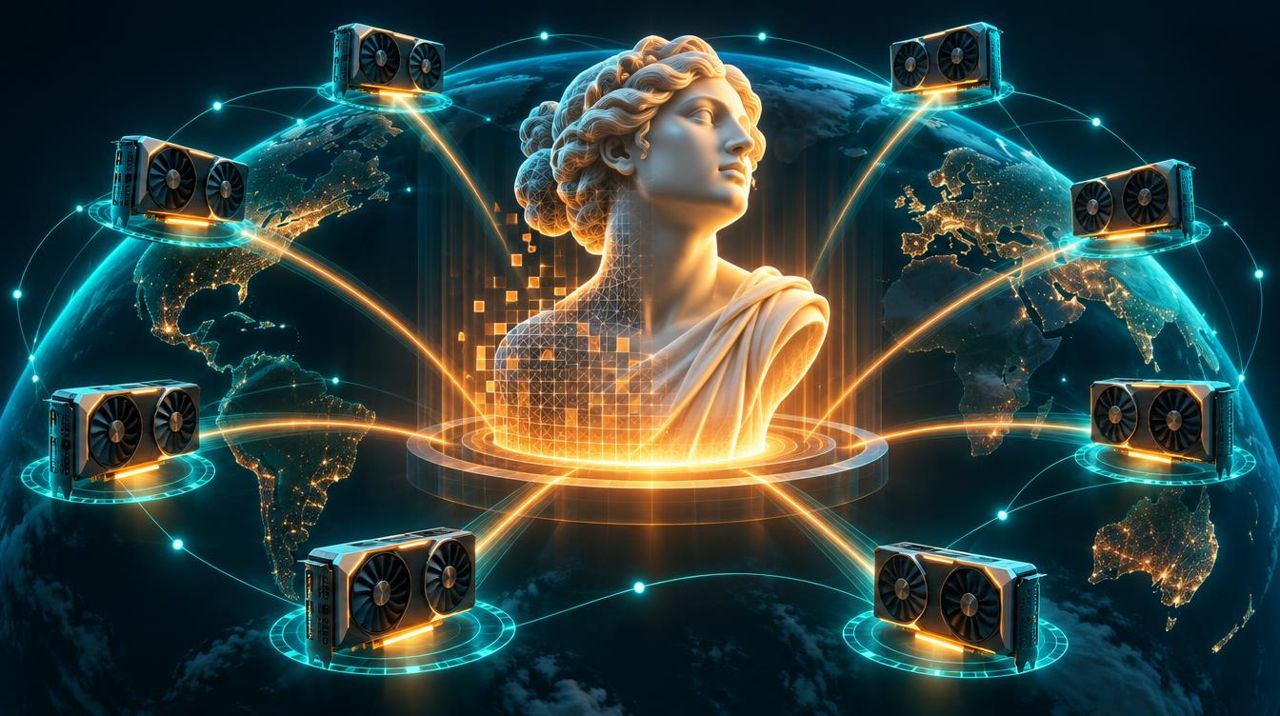
Render Network is a marketplace for GPU computing. Artists and studios pay to render 3D scenes (and increasingly to run AI jobs), and people with spare GPUs earn RENDER tokens for doing the work. It grew out of OTOY, the company behind the OctaneRender software, launched publicly in 2020 and moved its token from Ethereum to Solana in 2023.
| Type | Decentralized GPU compute (DePIN) |
|---|---|
| Origin | OTOY, founded by Jules Urbach |
| Public network launch | April 2020 |
| Token | RENDER (migrated from RNDR on Ethereum to Solana) |
| Token model | Burn-and-mint equilibrium |
| Main use | 3D rendering, expanding to AI/ML workloads |
What is Render Network?
3D rendering for films, games and motion graphics needs huge GPU power. Buying that capacity is expensive and it sits idle much of the time. Render Network connects "node operators" who have spare GPUs with "creators" who need rendering, through a peer-to-peer marketplace. Jobs are split up, sent to nodes, checked and returned.
How the token works: burn and mint
Since a community vote in 2023, Render uses a burn-and-mint equilibrium:
- Creators pay for jobs in fiat-equivalent prices, and the matching amount of RENDER is burned.
- Node operators are paid from newly minted RENDER according to a set emission schedule.
If network usage (burns) grows faster than emissions, supply can shrink; if usage is weak, emissions add supply. Watch actual burn data rather than marketing claims.
The move to Solana
In 2023 the community approved moving from Ethereum to Solana for faster, cheaper transactions. Holders migrated the old RNDR token to RENDER. If you still hold the old ERC-20 token, use only the official upgrade portal.
Render and AI
GPUs are the main bottleneck in AI. Render has expanded from rendering into machine-learning and generative AI workloads, which puts it in the decentralised physical infrastructure (DePIN) and AI token sectors. Competition is intense, from centralised clouds as well as other decentralised GPU networks.
Main risks to know
- Competition from big cloud providers with cheaper bulk pricing.
- Token value depends on real job volume, not GPU supply.
- Emission schedule adds supply if usage lags.
- Use only official migration tools; fake upgrade sites exist.
Frequently asked questions
Who created Render Network?
It grew out of OTOY, the company behind OctaneRender, led by founder Jules Urbach.
What is the difference between RNDR and RENDER?
RNDR was the Ethereum token; RENDER is the Solana-based token after the 2023 migration.
How do node operators earn?
They contribute GPU power to render jobs and receive RENDER emissions based on work done.
Is Render an AI coin?
It's mainly a GPU compute network for rendering that has expanded into AI workloads, so it's often grouped with AI and DePIN tokens.
Sources
- Render Network · Official site
- Render Network Foundation knowledge base · Burn-mint equilibrium and migration
- RENDER on CoinMarketCap · Market data
Figures such as prices, supply and user numbers change quickly. We cite the source and date; check the live figure before you act.